
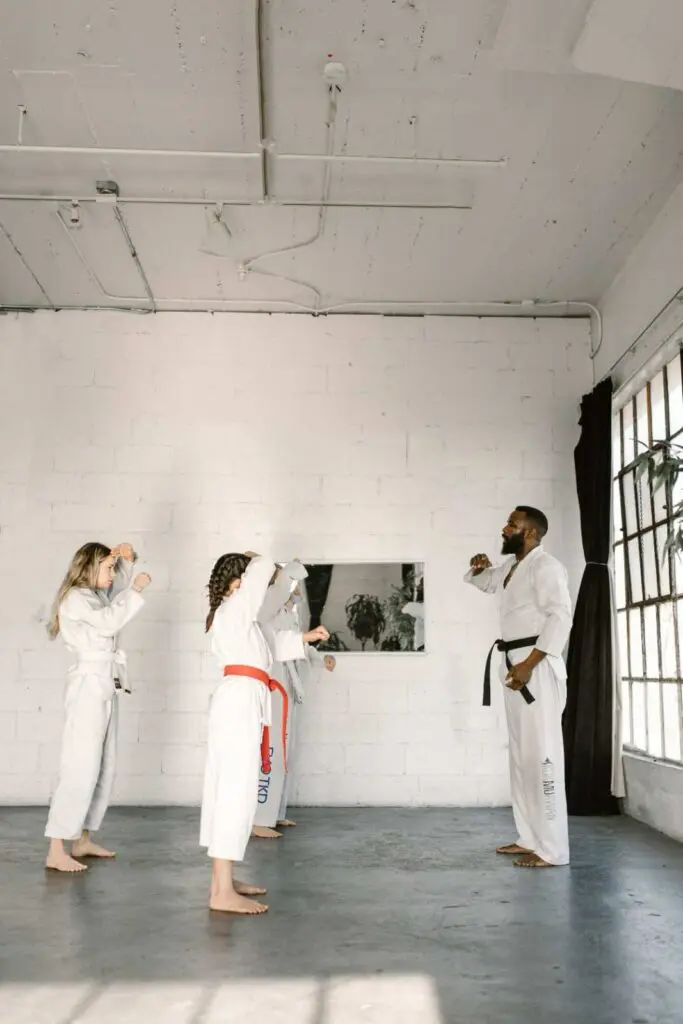
Most people think karate is all about power and speed. But without a solid grasp of karate training fundamentals, even the strongest punch means very little. The foundation you build in your first weeks of training shapes everything that comes after. Your stances, strikes, blocks, balance, and movement all connect back to these core basics.
We see many beginners rush through the fundamentals to get to the exciting moves. That is a mistake we want to help you avoid. Real progress in karate comes from developing correct posture, reliable body mechanics, and muscle memory through consistent practice. A proper closed fist, a stable stance, and a clean punch form are not small details.
They are what make more advanced techniques possible.
When our body learns to move the right way, we build balance, concentration, coordination, and the kind of control that makes karate both effective and safe. Whether your goal is self-defense, fitness, or competition, these building blocks carry you forward.
We put together this guide to give you a clear starting point for your karate practice. Read on to learn the core skills, drills, and principles every beginner should understand before moving further into training.
- What Are Karate Training Fundamentals?
- Why Beginners Learn Foundations Before Advanced Techniques
- Understanding the Basic Karate Stance
- Karate Stance and Movement Fundamentals
- Fundamental Karate Techniques for Striking
- Introduction to Basic Kicking Mechanics
- Basic Karate Strikes and Blocks for Defensive Skills
- What a Karate Block Is Designed to Do
- Distance and Timing in Karate
- Coordination and Body Mechanics
- How Karate Techniques Are Practiced
- Accuracy, Control, and Technique Before Power
- Karate Training Principles Beginners Should Remember
- Common Beginner Karate Mistakes
- How Karate Fundamentals Develop Over Time
- Building a Strong Foundation in Karate
- Common Questions About Karate Training Fundamentals
- Start Your Karate Journey With Confidence Today
What Are Karate Training Fundamentals?
Karate training fundamentals are the basic skills every beginner learns first: stances, strikes, blocks, movement, balance, and body control. Everything we do in karate, from simple punches to complex forms, relies on these skills. When we understand them well, advanced techniques become easier to learn and safer to practice.
Beginners need time to develop correct posture, coordination, weight distribution, and controlled movement. Rushing past these basics often creates habits that become harder to correct later. For students attending Karate classes in Spanaway, fundamentals provide a clear starting point for understanding how techniques work together instead of treating each movement as an isolated skill.
Why Beginners Learn Foundations Before Advanced Techniques
Learning karate basics for beginners first helps reduce unnecessary strain on the joints and muscles while building confidence through controlled, accurate movement. It also gives training a clear progression. Rather than memorizing techniques without context, students learn why each movement matters and how it connects to the next.

How Technique, Control, and Repetition Work Together
Good technique means performing a movement correctly and efficiently. Control means doing it precisely without losing balance. Repetition gives the body enough exposure to make the movement familiar.
Together, these elements develop muscle memory. At first, a stance, block, or punch may feel awkward because the body has never performed it before. With quality repetition, the movement becomes smoother and more automatic. That is why qualified instructors emphasize slow, deliberate practice early on.
We need to feel proper mechanics, including hip rotation and weight transfer, before trying to add speed and power.
Understanding the Basic Karate Stance
The karate stance is the starting position for almost every technique we perform. It determines where our weight sits, how wide our feet are, and how we hold our posture. A good stance gives us enough stability to support a technique while still allowing us to move.
Karate stance basics are not complicated, but they require regular correction. Small errors in foot position, posture, or weight distribution can affect balance, power, and mobility.
Balance and Weight Distribution
Balance is essential because we cannot strike, block, or change direction effectively if our base is unstable. Weight distribution refers to how we spread body weight between our feet according to the purpose of the stance.
As we train, we become more aware of where our weight is and how it affects movement. If too much weight is committed to one leg without purpose, changing direction becomes slow. When our weight is placed correctly, stepping, turning, striking, and blocking become more efficient.
Posture and Body Alignment
Correct posture means keeping the spine upright, shoulders relaxed, head up, and eyes forward. We avoid leaning too far ahead or behind our base.
Body alignment connects the upper and lower body so force can move efficiently through the technique. When posture breaks down, strikes lose structure, blocks weaken, and unnecessary stress can reach the back or joints. We often tell students to imagine a straight line running from the top of the head through the spine to the floor. Over time, this alignment becomes a natural habit.
Posture also supports awareness. Looking down at our feet or leaning heavily into a technique makes it harder to see what is happening in front of us.
Why a Stable Stance Matters
A stable stance gives us a solid base for striking, blocking, and moving under pressure. But stable does not mean rigid. The goal is to be grounded without becoming stuck. We want enough structure to perform the technique well and enough relaxation to transition smoothly into the next movement.
Karate Stance and Movement Fundamentals
Karate stance and movement go hand in hand. It is not enough to hold a strong stance while standing still. We need to preserve that base while stepping, sliding, pivoting, and changing direction.
This teaches an important beginner lesson: stance is not separate from technique. Every punch, block, kick, or combination happens while the body is either holding a position or moving through one.
Moving Without Losing Balance
Moving in a structured stance often feels awkward at first. The key is to keep the center of gravity stable and avoid unnecessary bobbing as we step. Smooth movement helps us remain balanced and ready to act.
Beginners should also avoid oversized steps. When a step carries our weight outside the base, recovery becomes slower. Smaller, controlled movements are usually more useful while learning.
Stepping Forward and Backward
Stepping in karate is more deliberate than normal walking. We move while maintaining stance width, posture, and awareness. When stepping forward, we push from the supporting leg into the next stable position. Moving backward reverses that action without letting posture collapse.
The feet should work together. If one moves too far or the stance becomes too narrow, balance changes. Repeating simple stepping drills helps us recognize the correct spacing without looking down.
Maintaining a Strong Base While Changing Direction
Changing direction requires coordinated footwork and body awareness. We pivot rather than crossing the feet unnecessarily or turning only from the shoulders. The feet, hips, and torso should work together so the body changes direction as one connected unit.
Beginners benefit from practicing turns slowly before adding speed. A fast direction change is only useful if we remain balanced at the end.
Common Beginner Movement Mistakes
Many beginners make the same movement mistakes: standing too upright, crossing the feet, narrowing the stance, taking steps that are too large, moving too quickly before mastering control, looking down, or allowing the shoulders to lean ahead of the hips. Each one weakens our position and makes it harder to execute techniques while moving. Correcting these habits early saves frustration later.

Fundamental Karate Techniques for Striking
Striking is one of the most visible parts of karate, but it is not simply about hitting hard. Fundamental karate techniques for striking rely on form, distance, timing, balance, and body coordination.
Beginners often notice the hands or feet first. In reality, effective striking begins with the stance, legs, hips, and core. The striking limb is the final part of a coordinated full-body action.
Basic Punching Mechanics
One of the first punches many beginners practice is the straight punch. We form a closed fist with the thumb safely outside the fingers, keep the wrist aligned, and extend the punch from a chamber position.
Chamber refers to the starting or preparatory position of a technique. For many basic punches, the hand begins near the side of the body while the non-punching hand retracts as the other extends. This counter-movement teaches coordination between both sides of the body.
Karate punch form may also involve rotating the fist during extension, depending on the technique. The movement should remain controlled. Beginners should avoid aggressively locking the elbow at full extension. Proper alignment protects the joint and makes it easier to recover the hand quickly.
Using the Whole Body Rather Than Only the Arm
A punch powered only by the arm is limited. We use the legs, stance, hips, and core to generate and transfer force. Hip rotation supports the strike while the core connects the lower and upper body.
Learning this connection takes time, but the difference is easy to feel. A coordinated punch feels more stable and efficient than one produced by muscular effort alone. The same principle applies to palm strikes and kicks: good karate technique comes from the body working as a connected unit.
Introduction to Basic Kicking Mechanics
Kicks are another major part of karate training fundamentals. Two common beginner examples are the front kick and roundhouse kick. Both require balance, posture, hip mobility, chambering, and controlled recovery.
For a front kick, we lift the knee into a chamber before extending the lower leg. A roundhouse kick requires us to pivot on the supporting foot as the hips turn and the kicking leg travels toward the target. In both cases, coordination matters more than simply swinging the leg.
Kicking challenges balance because one foot leaves the floor. Beginners should practice slowly, learning the path of the technique before trying to make it fast. A complete kick also includes retraction. We bring the leg back under control rather than dropping it immediately, allowing us to return to a stable stance.
Control Before Speed and Power
In karate, control comes before speed and power. Rushing into force too early reinforces poor mechanics and makes balance harder to maintain. Slow practice gives us time to check posture, chamber, pivot, extension, and recovery. Once those elements are reliable, speed and power can develop from better technique instead of replacing it.
Basic Karate Strikes and Blocks for Defensive Skills
Defense is just as important as offense. Basic karate strikes and blocks are often taught together so students understand both sides of an exchange. Effective blocking requires us to recognize an attack, move appropriately, and use the right defensive action at the right moment.
Learning basic Karate blocks for beginners reinforces stance, posture, chambering, coordination, and positioning. The goal is not simply to memorize arm motions. We learn how the whole body supports defense.
What a Karate Block Is Designed to Do
A karate block may redirect, intercept, or manage an incoming strike. We are not always trying to absorb force directly. Often, the goal is to change the path of the attack while improving our own position.
Even simple blocks teach efficiency. Correct angle, timing, stance, and body mechanics can make a defensive movement work without relying on unnecessary force.
Common Beginner Blocking Motions
Beginners may practice an upper block for attacks toward the head, inside and outside blocks for appropriate mid-level attacks, and a low block for the lower area. These motions also teach chambering and coordination between both sides of the body.
A block should not become an exaggerated arm swing. The movement stays connected to the stance, shoulders, hips, and core so it can be repeated with structure and control.
Positioning and Timing
A technically correct block can still fail if we are in the wrong place or move at the wrong moment. Positioning means being at an effective distance and angle. Timing means responding when the defensive movement can actually influence the attack.
Beginners usually start with predictable attacks so they can focus on technique. As confidence improves, partner drills become more dynamic and require better decision-making.

Defense as Part of Movement
Defense does not always mean standing still and blocking. We may step or shift to a better position while defending. Moving slightly off the direct line of an attack can improve our angle and reduce how much force we need to manage.
This teaches us to see defense as dynamic. We are not simply waiting for an attack to reach us; we are adjusting position, protecting ourselves, and preparing for what comes next.
Distance and Timing in Karate
Distance and timing are two of the most important elements in karate. They are less obvious than punches or stances, but they shape whether a technique works at all. A movement can look perfect in the air and still fail against a partner if the range or timing is wrong.
Understanding Training Distance
Training distance refers to how far we are from a partner or target. Different techniques require different ranges. A punch must reach with correct extension, while a kick may need more room depending on the technique.
Too close and the movement may lose structure. Too far and it will not reach. Because distance changes whenever partners move, we also learn to recognize when we have entered or left useful range.
Why Timing Matters as Much as Technique
Perfect technique performed too late may not help us. Timing means recognizing when to move. We develop it through partner training and beginner karate drills that require us to watch and respond to real movement.
Timing is not the same as raw speed. A controlled technique performed at the correct moment can be more effective than a faster movement made without awareness.
Learning to Recognize Openings Safely
An opening is a moment when a partner’s defense leaves a gap. Beginners learn to recognize these moments through structured exercises where the situation is predictable enough to remain safe.
These drills also teach restraint. Seeing an opening does not mean striking with full power. Responding with control is part of becoming a reliable training partner.
Coordination and Body Mechanics
Coordination is the ability to move different parts of the body together smoothly. In karate, the hips, core, arms, and legs need to support one another. Body mechanics describes how posture, rotation, alignment, and weight shift allow us to generate and transfer force efficiently.
Connecting the Hips, Core, and Upper Body
The hips contribute to many strikes, blocks, and turns, while the core connects that motion to the upper body. Beginners sometimes rotate the shoulders without the hips or turn the hips while the upper body falls out of alignment.
Slow, deliberate practice helps us connect these areas. Once the movement becomes coordinated, techniques feel smoother and more stable without requiring extra effort.
Developing Left- and Right-Side Coordination
Most of us have a dominant side that feels more natural. Karate requires us to practice both sides. This improves coordination, body awareness, and our ability to respond from different positions.
The weaker side may take longer to learn a movement, but avoiding it only preserves the imbalance. Consistent repetition gradually makes both sides more capable.
Breathing During Karate Techniques
Breathing is easy to overlook. Beginners often hold their breath while concentrating, which creates tension and reduces endurance. We commonly exhale during the execution of a technique to support rhythm and core engagement while staying more relaxed between movements.
With practice, breathing becomes less conscious and more naturally connected to technique.
How Karate Techniques Are Practiced
Karate uses several practice formats, each developing a different part of our skill. Together, they take us from isolated movement to coordinated sequences and partner interaction.
Repetition and Technical Drills
Repetition is central to muscle memory. Beginner karate drills often isolate one technique or movement pattern at a time so we can focus on stance, chambering, striking path, footwork, breathing, or recovery.
Breaking techniques into smaller parts makes mistakes easier to identify. Once those pieces improve, we can combine them into a complete movement with greater consistency.
Individual Practice
Individual practice may include mirrors, shadow training, or working in an open space. It allows us to focus on our own movement without the distraction of a partner and helps develop discipline and self-awareness.
However, solo practice works best when we already understand the technique correctly. Repeating an error at home can reinforce it, so beginners still benefit from regular instructor feedback.
Partner Training
Partner training adds real human movement. It develops distance, timing, awareness, and reaction in ways solo practice cannot fully reproduce.
A coached progression begins slowly and with control. Instructors guide the drill before speed or complexity increases. Good partner training also teaches communication and responsibility because both people need to match the drill and provide useful, manageable movement.
Structured Combinations and Sequences
As individual techniques become familiar, we begin combining them. Structured combinations teach us to move from one action to the next without losing stance, posture, or control.
Forms, also known as kata, are prearranged sequences that can include striking, blocking, stepping, turning, rhythm, and direction changes. Beginners first focus on remembering the sequence and performing each movement correctly. With experience, they begin to understand how the movements connect and what they may represent.
Kumite and other partner formats develop a different set of skills. Instead of following a fixed solo sequence, we respond to another person and apply timing, distance, control, and awareness. Both forms of practice support the same fundamentals from different angles.

Accuracy, Control, and Technique Before Power
One of the clearest karate training principles is accuracy before power. Many students want to move quickly or hit hard right away, but power built on poor mechanics is difficult to control and can reinforce bad habits.
Why Beginners Should Avoid Rushing
Rushing through technique produces unreliable movement. A student who takes time to learn correctly at the beginning often progresses more efficiently later because advanced skills have a stable foundation.
Patience matters even when a technique looks simple. A straight punch or basic stance may take years to refine. Returning to the details is part of karate, not evidence that progress has stopped.
Developing Consistency
Consistency means performing a movement correctly again and again, eventually even when we are tired, moving, or responding to a partner. We build it through frequent practice at an intensity we can control.
There is little value in adding speed before the current movement is reliable. When stance, posture, and basic technique are consistent, combinations become easier to learn because fewer elements break down at once.
How Controlled Practice Builds Better Habits
Controlled practice gives the brain and body clear information. Slowing down helps us recognize exactly where an error appears and apply instructor feedback before that mistake becomes automatic.
We train form and flow first. Once the movement is stable, speed and power can develop without sacrificing control.
Karate Training Principles Beginners Should Remember
Certain principles apply to almost every drill and technique. Keeping them in mind makes training safer, more efficient, and easier to understand.
Keep a Stable Base
A stable base supports striking, blocking, and movement. We continue paying attention to stance and footwork even when the drill focuses on something else.
Protect Your Position
Good karate includes returning to a useful position after a technique. A punch does not end at full extension, and a kick does not end when it reaches the target. We recover our guard, posture, and stance so we are ready to continue.
Relax Until the Moment of Technique
Excess tension makes movement slower and wastes energy. We learn to stay relaxed between actions and engage the muscles when structure is needed. This balance between relaxation and control is part of efficient body mechanics.
Maintain Awareness and Control
Awareness means knowing where we are, where our partner is, and what is happening around us. Control means managing our own movement with precision. Together, they help us train safely and respond appropriately when intensity changes.
Focus on Quality Repetitions
Not all repetitions are equal. Mindless practice can reinforce mistakes just as easily as it reinforces good technique. We aim for focused repetitions, recognizing errors and making corrections rather than simply completing a high number of movements.

Common Beginner Karate Mistakes
Mistakes are a normal part of learning karate basics for beginners. The goal is to recognize them early and correct them with help from an instructor.
Standing Too Stiffly
Beginners often grip too hard, raise the shoulders, or tense the entire body. This wastes energy and limits speed. Relaxation does not mean becoming loose or careless; it means removing unnecessary tension while preserving posture and structure.
Overreaching During Techniques
Overreaching happens when we stretch beyond a stable range to land a strike or block. This pulls the body off balance. Better distance and footwork allow us to adjust position instead of leaning or reaching farther with the upper body.
Sacrificing Balance for Speed
Moving quickly before balance is reliable produces sloppy technique. We build stability first, then add speed. Reversing that order usually creates more corrections later.
Holding the Breath
Holding the breath increases tension and reduces endurance. Regular breathing helps us stay relaxed and better prepared for longer combinations or drills.
Trying to Generate Too Much Power Too Soon
Maximum effort before correct form can create poor mechanics and unnecessary strain. Power should grow from alignment, coordination, hip movement, timing, and weight transfer rather than being forced from the beginning.
Looking Down During Movement
Beginners often watch their feet because they are unsure of placement. Over time, we learn to feel our stance without checking it visually. Keeping the eyes forward supports posture and awareness of the partner or target.
How Karate Fundamentals Develop Over Time
Karate training fundamentals do not disappear as we improve. Our understanding of them becomes deeper. What once felt mechanical begins to feel natural, and simple movements reveal more detail.
A beginner may think of stance as placing the feet correctly. Later, that same student understands how stance affects distance, timing, power, movement, and recovery. The basic idea remains, but the level of understanding changes.
Building Reliable Movement Patterns
With enough practice, movements become increasingly automatic. We no longer need to consciously remember every step of a familiar technique, which allows us to focus on timing, strategy, or the partner in front of us.
Automatic movement does not mean careless movement. Experienced students still refine details. They simply manage those details with greater familiarity.
Combining Individual Techniques
Once individual skills are dependable, we combine them into flowing sequences. A punch can lead into a block, a turn, or a kick without each technique feeling separate.
This layered approach helps us understand how the finishing position of one movement can become the starting position of the next. Karate becomes less about collecting isolated moves and more about connecting them efficiently.
Improving Timing and Precision
As stance, posture, distance, and alignment become more reliable, timing and precision improve. We can recognize openings sooner, place blocks more effectively, and strike with greater accuracy because fewer basic elements demand conscious attention.
Progressing Toward More Complex Training
Eventually, training includes more complex combinations, kata, and sparring formats. But the same fundamentals remain underneath them. Advanced karate is not separate from the basics; it is a more refined and adaptable expression of them.
Building a Strong Foundation in Karate
A strong foundation means our stances, strikes, blocks, and movement are increasingly reliable and controlled. Without that base, advanced techniques have nothing stable to build on.
Why Fundamentals Remain Important at Every Level
Even black belts continue to practice basic stances, punches, blocks, and footwork. Experience does not make fundamentals less important. It allows practitioners to understand and perform them with greater precision.
Seeing experienced students return to basics also gives beginners a useful perspective: fundamentals are not something we leave behind once we earn a higher rank.
Consistency Versus Fast Progress
Many beginners want to progress quickly, but consistent training matters more than rushing through material. Progress often appears in small improvements: standing more comfortably in a stance, recovering a kick with better balance, breathing through a combination, or maintaining posture while changing direction.
Those changes may not feel dramatic, but they accumulate. Showing up, practicing with intention, listening to feedback, and improving familiar techniques is how strong skill develops over time.
What Beginners Should Focus on First
In the first stage of training, focus on correct posture, basic stances, controlled punches and kicks, fundamental blocks, balanced footwork, steady breathing, and recovering to a useful position after each technique. Keep your eyes forward, train both sides of the body, and work with a qualified instructor who can correct small errors before they become habits.
Most importantly, prioritize consistency over advanced movement. A reliable foundation gives you more freedom later because your body already understands how to move with balance and control.

Common Questions About Karate Training Fundamentals
1. What should a beginner learn first in Karate?
Beginners typically start with posture, balance, basic stances, movement, simple strikes, and defensive techniques. These skills teach body control before more complex combinations are introduced.
They also learn how to listen to instruction, recover their stance, move safely, and practice with control. Those habits are just as important as memorizing individual techniques.
2. Why are stances so important in Karate?
Stances provide the stable base needed for movement, striking, and defense. A balanced stance helps us transfer weight efficiently while remaining controlled.
They also develop body awareness because small changes in foot position, posture, or weight distribution affect the rest of the technique.
3. Should Karate beginners focus on power or technique first?
Beginners should prioritize technique, balance, accuracy, and control before maximum power. Correct movement patterns create a safer and more efficient foundation for speed and force.
Once alignment, timing, and coordination improve, power can develop more naturally through the whole body.
4. How long does it take to become comfortable with Karate fundamentals?
There is no single timeline. Some movements may feel comfortable after a few classes, while others take months of consistent practice.
The goal is not to reach a point where the fundamentals are finished. Even experienced students continue refining stance, timing, posture, breathing, and movement.
5. Can Karate fundamentals be practiced at home?
Many basic movements can be reviewed at home after a qualified instructor has shown us how to perform them correctly. Stances, stepping patterns, posture, controlled punches, and slow kicking chambers can all be practiced in a safe, clear space.
Home practice should reinforce class instruction rather than replace it. Regular feedback helps prevent small errors from becoming long-term habits.
6. Why does Karate practice involve so much repetition?
Repetition turns unfamiliar movements into reliable patterns. Performing a technique once may help us understand the idea, but careful repetition gives the body time to learn the coordination.
The key is focused repetition. Practicing the same mistake hundreds of times only makes that mistake more familiar. Quality practice means paying attention, applying feedback, and adjusting as we repeat the movement.

Start Your Karate Journey With Confidence Today
Karate training fundamentals give you a strong base for everything that follows. You learn correct posture, stable stances, controlled movement, basic strikes, blocks, and kicks while building balance, coordination, awareness, and concentration.
The fundamentals may look simple from the outside, but each one teaches something important. Stance teaches structure and balance. Footwork teaches us to preserve that structure while moving. Strikes connect the legs, hips, core, and arms.
Blocks develop timing and positioning. Kicks challenge us to stay controlled when our base changes.
These skills do not develop all at once. They grow through regular practice, correction, and repetition. Some days a technique will feel natural; on others, the same movement may feel awkward. That is part of learning.
Your next step is simple: choose one drill from this guide and practice it for 10 minutes each day this week. Focus on form before speed or power. Pay attention to stance, posture, breathing, balance, and recovery.
Developing muscle memory takes time, but small corrections repeated consistently create meaningful improvement. You do not need to be perfect to start. You just need to begin.